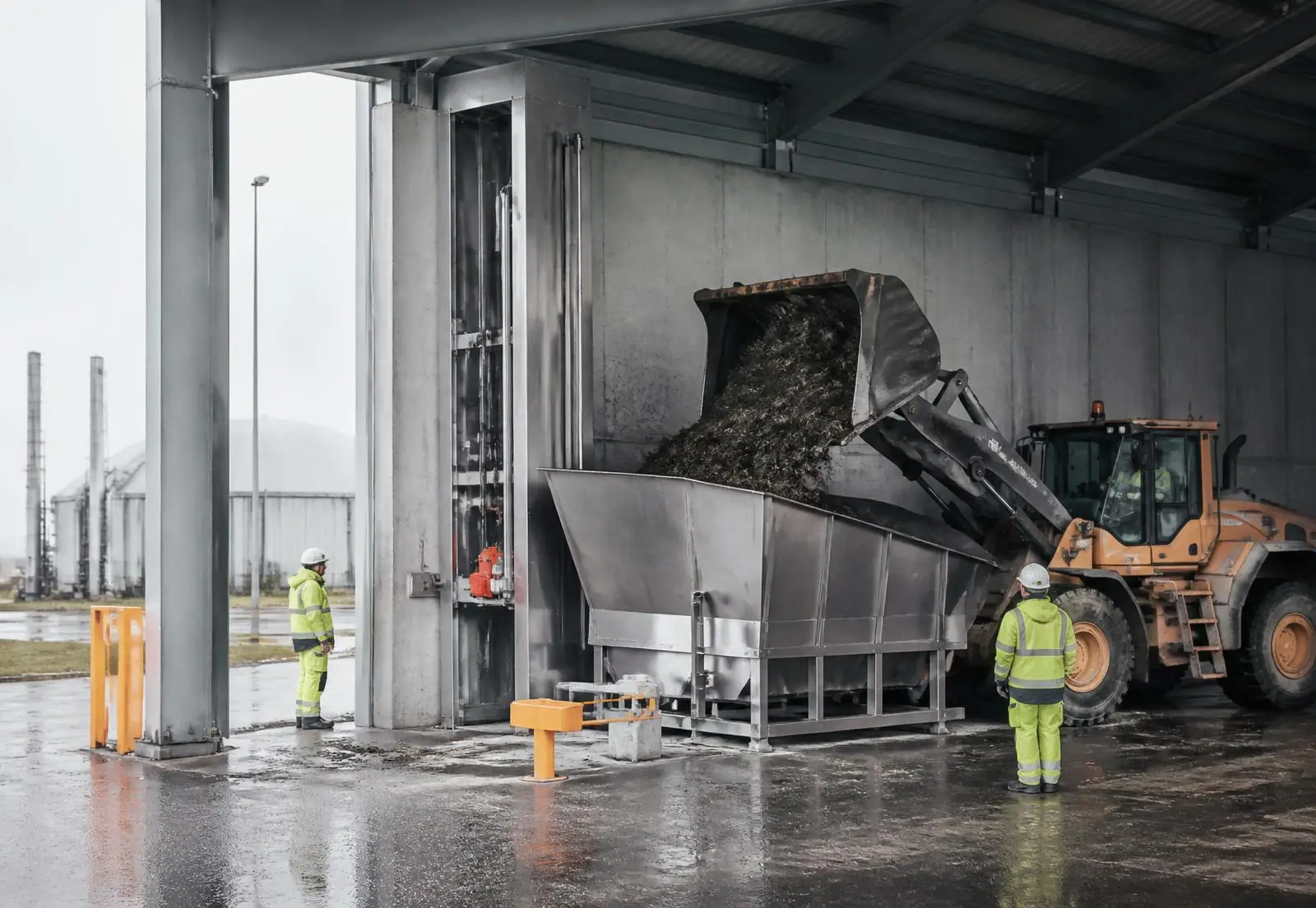
Sourcing from food-waste-based streams
Food-waste-based feedstock can come from several kinds of source stream. What matters is not the label but the actual material: where it arises, how it is collected, how it is kept separate from other waste, and how consistent it is over time. Those practical realities decide whether a stream can serve biogas production reliably.
Quality is agreed, not assumed
Every receiving plant runs its own acceptance picture: composition ranges, contamination limits, physical form, hygiene and documentation. We match material against those requirements instead of assuming a generic "food waste" fits every digester.
Logistics shape the cooperation
Collection points, tank or container form, transport distance, delivery frequency and reception windows are part of the commercial equation, not an afterthought. A feedstock route only works when the material arrives in the right form, at the right rhythm, with the right paperwork.
Part of a wider material portfolio
Food-waste-based feedstock sits alongside our work with RDF, SRF and woodchip biomass. The principle is the same across all of them: match the material to the receiving operation, and define the cooperation before the first delivery.